
If AI is supposed to feel seamless, why does it still seem split between the cloud, your laptop, your phone, and the gadgets around you?
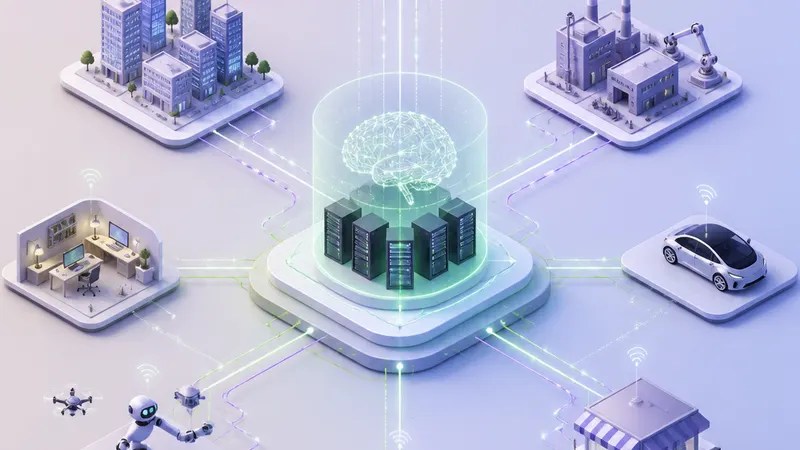
That is the problem NVIDIA is pointing at with its idea of an AI Grid. In the company’s recent NVIDIA Technical Blog post, the message is straightforward: AI should not live in one place. It needs to run across cloud systems, enterprise servers, and devices at the edge—meaning hardware closer to where data is created, like cameras, robots, cars, or local PCs.
For everyday users, that may sound abstract. But the real-world meaning is simple: faster responses, smarter apps, and more choices about where your data gets processed.
Quick Summary
The AI Grid is NVIDIA’s vision for connecting AI infrastructure across cloud platforms, AI data centers, and edge AI devices.
Instead of treating AI as something that only happens in giant remote servers, the idea is to coordinate many kinds of computing systems so they can handle different AI workloads—the tasks AI systems perform, such as training, inference, or real-time decision-making.
Why it matters to you: apps may become quicker, devices may do more locally, and companies may get more flexibility in balancing speed, cost, and privacy.
What NVIDIA means by an AI Grid
At its core, the AI Grid is about orchestration. In plain English, that means managing where AI jobs run and how different systems work together.
NVIDIA’s framing suggests a world where intelligence is distributed. Some tasks may happen in large-scale AI data centers, which are centralized facilities packed with computing hardware. Other tasks may happen at the edge, closer to users and machines.
That matters because not every AI task has the same needs.
A large language model may need powerful centralized hardware for training. A factory robot, by contrast, may need instant local responses. A video analytics system may need both: central systems for model updates, local systems for live decisions.
So when NVIDIA talks about orchestrating intelligence everywhere, the practical takeaway is this: AI may increasingly be placed where it works best, not just where compute is biggest.
Why this matters beyond the tech industry
For users, the biggest benefit may be responsiveness.
If more AI runs on nearby systems or on-device, some features could feel faster because data does not always need to travel back and forth to a distant cloud. That is especially relevant for edge AI, where timing matters.
There is also a privacy angle.
When AI can process some information closer to the source, companies may have more options to avoid sending every piece of raw data to centralized servers. That does not automatically guarantee privacy, but it can change the design choices available to app makers and businesses.
And then there is reliability.
A more distributed setup may help certain services keep working even when connectivity is limited. Again, that depends on the application, but it is one reason the idea of broader AI infrastructure is getting attention.
The bigger shift in AI infrastructure
The NVIDIA technical blog points to a future where AI infrastructure is not just one giant cluster in one location.
Instead, it may look more like a connected fabric of resources: cloud services, enterprise systems, and edge devices all participating in AI workflows. That is a meaningful shift because AI adoption is expanding into more physical, real-time environments.
Think about the difference between asking a chatbot a question and running AI in a warehouse, hospital, retail store, or vehicle. The second group often has tighter timing, location, and operational demands.
That is where the AI Grid idea becomes more than branding. It reflects a broader industry push to make AI usable outside classic cloud-only setups.
What users should watch for
Faster features, but uneven rollout
You may start seeing more products claim local or hybrid AI support. “Hybrid” usually means some work happens on-device and some in the cloud.
That could improve speed and reduce lag. But rollout will likely vary by device, app, and region.
More invisible complexity
For users, the best AI experiences often feel simple. Behind the scenes, though, they may rely on a complicated mix of cloud and edge systems.
That complexity can be useful if it gives you better performance. But it also means trust matters. Users will want clearer answers about where data goes and what is processed locally.
New pressure on infrastructure
An AI Grid depends on strong coordination across many systems. That means companies need tools to manage different AI workloads efficiently.
In other words, smarter apps do not just require smarter models. They also require smarter plumbing.
What this likely means for the next phase of AI
The clearest message from NVIDIA AI Grid thinking is that the future of AI may be less centralized than many people assumed.
Not because the cloud is going away—it is not—but because AI is spreading into more places where local speed, autonomy, and operational control matter.
For consumers, that could mean assistants and devices that feel more immediate.
For businesses, it may mean redesigning how they deploy AI across offices, factories, stores, and field operations.
For the market as a whole, it reinforces a simple truth: AI is no longer just about building bigger models. It is also about deciding where intelligence should live.
FAQs
What is the AI Grid in simple terms?
It is NVIDIA’s idea for connecting cloud, data center, and edge systems so AI can run in the most useful place for each task.
How is NVIDIA AI Grid different from regular cloud AI?
Cloud AI usually centers on remote servers. NVIDIA AI Grid points toward a more distributed model, where some AI workloads may run in centralized infrastructure and others closer to the user or device.
Why should regular users care about orchestrating intelligence everywhere?
Because it may affect how fast apps respond, how devices work when connectivity is limited, and how companies handle data processing across cloud and edge environments.
Sources
Internal link suggestions
- A beginner’s guide to edge AI and on-device computing
- How AI data centers differ from traditional cloud infrastructure
- What AI workloads are and why model deployment is getting more complex

