Deep Agents for Enterprise Search with NVIDIA AI-Q
Tech teams exploring deep agents for enterprise search are starting to look beyond basic chat interfaces and simple retrieval pipelines. A recent NVIDIA technical blog outlines how NVIDIA AI-Q and LangChain can be used together to build more capable search agents for enterprise use cases.
For readers trying to understand what this means in practice, the key idea is straightforward: instead of a single prompt calling a single model, an agent can coordinate multiple steps, tools, and retrieval paths to answer harder business questions.
Quick Summary
- NVIDIA’s technical blog describes how to build deep agents for enterprise search with NVIDIA AI-Q and LangChain.
- The approach centers on agentic AI, where AI agents can plan, retrieve information, and use tools across multiple steps.
- This builds on familiar retrieval augmented generation patterns, but aims to support more complex enterprise workflows.
- For enterprise teams, the main takeaway is that stronger search experiences may depend on orchestration, tool use, and governance—not just a larger model.
What NVIDIA AI-Q and LangChain are doing here
According to NVIDIA’s developer blog, the combination of NVIDIA AI-Q and LangChain is presented as a way to create enterprise search systems that go deeper than standard question answering.
In broad terms, LangChain is used as an application framework for chaining model calls, retrieval, and tool usage. NVIDIA AI-Q is positioned in the blog as part of the stack for building these more advanced agent workflows.
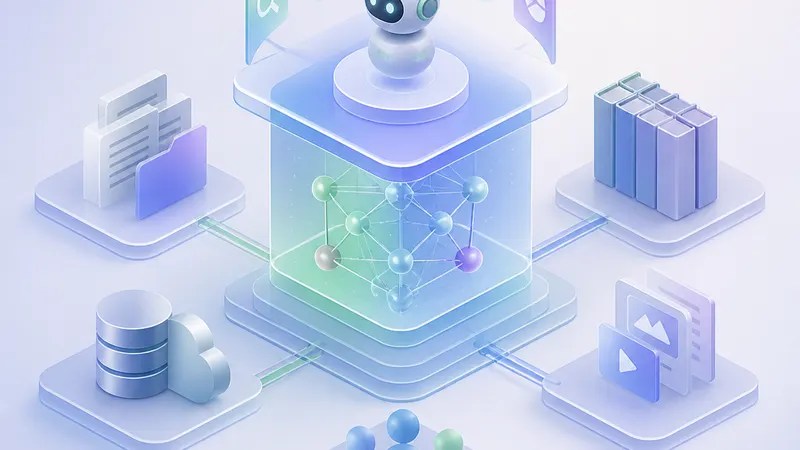
The article frames this as an enterprise AI pattern where search is no longer limited to pulling back a few documents and summarizing them. Instead, an agent may break a task into steps, query relevant sources, and reason through the results before responding.
That matters because many enterprise questions are not simple lookups. They often require combining policy documents, internal knowledge, and context from multiple systems.
Source: NVIDIA Technical Blog
Why deep agents for enterprise search matter
Traditional enterprise search can struggle when users ask layered questions.
A standard RAG for enterprise search setup usually retrieves documents and asks a model to generate an answer from them. That works well for many tasks, but it may be less effective when the request involves several sub-questions, tool calls, or decision paths.
The NVIDIA blog’s focus on “deep agents” suggests a more structured approach. Rather than treating every query as a one-shot interaction, the system can reportedly manage multi-step reasoning and retrieval.
This is where agentic AI becomes relevant. In an agent-based setup, the model is not just generating text. It may also decide when to search, what source to query, and how to combine findings into a final answer.
For enterprise users, that can be useful in scenarios such as:
- answering questions that span multiple internal knowledge sources
- handling requests that need several retrieval passes
- supporting workflows where search and action are closely connected
How this differs from basic retrieval augmented generation
From single retrieval to multi-step orchestration
Basic retrieval augmented generation often follows a simple path:
- receive a user query
- retrieve relevant content
- generate an answer
The approach described by NVIDIA points toward something more layered. A deep agent may repeat retrieval, use tools, and refine its path before producing a response.
That makes the system more like an orchestrator than a chatbot.
Why LangChain fits the model
Because LangChain is commonly used to connect prompts, tools, and retrieval flows, it fits naturally into this kind of architecture. In the NVIDIA write-up, it is part of the implementation path for assembling these agent behaviors.
For developers, that means the value is less about one standalone feature and more about how components are coordinated.
What enterprise teams should know before adopting it
The most important point is that better search quality may come from system design, not only model choice.
If a company is evaluating deep agents for enterprise search, a few practical questions come first:
What sources can the agent access?
Enterprise search quality depends on the underlying knowledge sources. If content is fragmented, outdated, or poorly permissioned, an agent may still produce weak answers.
How much autonomy should the agent have?
An enterprise may want an agent to retrieve and summarize, but not to take actions without oversight. Agent design should match the organization’s risk tolerance.
Is the workflow auditable?
For enterprise AI, traceability matters. Multi-step systems can be more capable, but they can also be harder to inspect if teams do not log retrieval steps, tool calls, and outputs.
Does RAG alone already solve the problem?
Not every use case needs a deep agent. Some teams may find that a simpler RAG for enterprise search pipeline is enough. Deep agents appear most useful when questions require planning, iteration, or multiple tools.
The bigger takeaway
The NVIDIA post is a useful signal of where enterprise search design is moving. The emphasis is shifting from “ask a model a question” toward building systems that can search, plan, and reason across steps.
That does not mean every enterprise should immediately replace existing search stacks. But it does suggest that AI agents may become a more common pattern for organizations that need richer internal knowledge workflows.
For technical buyers and builders, the message is clear: if your search problem is complex, the architecture around the model may matter as much as the model itself.
FAQs
What are deep agents for enterprise search?
They are agent-based systems designed to handle enterprise search tasks through multiple steps, such as retrieval, tool use, and reasoning, instead of relying on a single prompt-and-response flow.
How do NVIDIA AI-Q and LangChain fit together?
Based on NVIDIA’s technical blog, NVIDIA AI-Q and LangChain can be used together to build agent workflows for enterprise search, with LangChain helping coordinate tools, retrieval, and model interactions.
Is this different from standard RAG for enterprise search?
Yes. Standard retrieval augmented generation usually focuses on retrieving documents and generating an answer. Deep agents may go further by planning tasks, repeating retrieval, and using tools across several steps.
Sources
- NVIDIA Technical Blog: How to Build Deep Agents for Enterprise Search with NVIDIA AI-Q and LangChain
Internal link suggestions
- A beginner’s guide to retrieval augmented generation for enterprise AI
- LangChain explained for IT and data teams
- What agentic AI means for enterprise software buyers

